youtube bumper ad cost
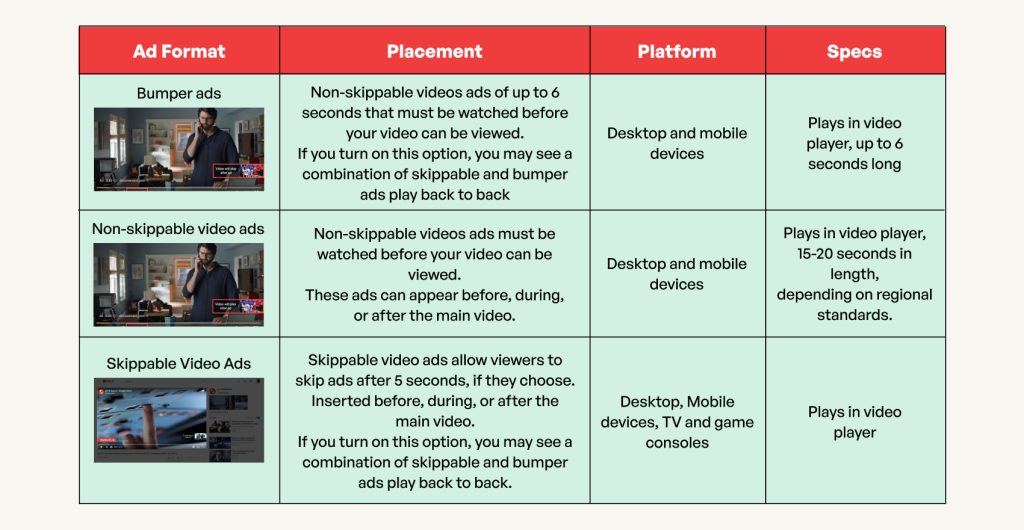
The youtube bumper ad cost is always a variable that forces many brands to consider carefully before implementation, especially since its few-second duration is still subject to bidding mechanisms and viewer behavior. Unlike long-form formats, the budget for short ads often fluctuates based on impression frequency, audience competitiveness, and how the system evaluates content quality. Without a clear strategy, costs can escalate quickly while the memorability remains disproportionate. Conversely, with a proper understanding of allocation and control, the youtube bumper ad cost can be maintained at a reasonable level while still achieving brand coverage goals. The issue lies in choosing the right format, content structure, and bidding method that aligns with communication objectives.
How YouTube Bumper Ad Costs Are Formed in Real-World Distribution
Bumper ads, the unskippable 6-second video format, operate based on a real-time bidding model on the YouTube platform. Unlike traditional advertising types with fixed listed prices, the youtube bumper ad cost for each campaign is formed through a dynamic auction system. Here, the final value of each impression depends on the complex intersection between content quality metrics and market variables at the time of distribution.
Bidding Mechanism and Industry Competition
In the Google ecosystem, bumper ads are distributed through an auction among millions of advertisers simultaneously. The CPM (cost per 1,000 impressions) that a business must pay is directly influenced by the level of competition within its industry. Sectors with large profit margins are often willing to push bid prices high to capture the most prime display positions, inadvertently setting a new price floor for the entire industry.
Actual data shows a clear divergence: in the finance, insurance, or luxury real estate sectors, the average youtube bumper ad cost (CPM) can range from $5.00 to $8.50. Meanwhile, in the Fast-Moving Consumer Goods (FMCG) industry with a mass audience and more spread-out competition, CPM usually stays around $1.60 to $3.00. This disparity confirms that for the same 6-second duration, the value of a reach in “niche” industries or high-order-value sectors is always significantly more expensive than in common consumer industries.
The Correlation Between Impression Frequency and Budget Depletion
A key technical factor affecting the rate of budget depletion is impression frequency. Frequency determines the average number of times a unique user sees your ad during a campaign cycle. If advertisers do not set frequency limits scientifically, the system will concentrate on showing the ad too many times to a narrow audience segment, leading to wasted budget without expanding new reach scales.
Consider a specific example: a campaign with a $4,000 budget. If the business sets a frequency cap of 3 times/week, the ad can reach approximately 1,000,000 unique users (assuming a CPM of $1.33). However, if the frequency is pushed to 10 times/week for that same audience, the budget will be exhausted quickly while the number of newly reached users will decrease significantly. This creates a “saturation point,” where additional spending no longer adds value to brand awareness and increases the risk of negative sentiment due to overly dense repetition.
Same Duration but Different Campaign Costs
Many advertisers wonder why two videos, both 6 seconds long and running on YouTube, have completely different cost reports. The answer lies in targeting layers and the quality of the placement. YouTube’s algorithm rewards ads with high relevance to users and applies different pricing based on the following criteria:
- Geographic Location: Running bumper ads in major markets or bustling cities often results in CPMs 20% to 30% higher than in rural areas due to fiercer competition.
- Interest Targeting: Targeting an audience with specific behaviors, such as “people intending to buy a car,” will be 1.5 to 2 times more expensive than “basic demographic” targeting (like age or gender).
- Device Display: Ads displayed on Smart TVs usually have a significantly higher CPM than mobile phones. For example, CPM on CTV can reach $8.00 – $12.00, as this is a high-quality viewing environment that brings better brand value and focus.
The synthesis of factors from audience and location to device creates continuous fluctuations in the youtube bumper ad cost, forcing ad experts to constantly optimize to find the “sweet spot” between budget and actual display performance.
Factors Silently Driving Bumper Ad Costs Up or Down

These factors often do not appear directly in the price list but directly steer the ad distribution flow to expensive or cheap positions. To optimize budget, advertisers need to deconstruct the technical components impacting this volatility, starting with the compatibility between the message and the viewing environment.
Content Relevance to the Viewing Context
Google prioritizes user experience by evaluating the relevance between the video ad and the content the user is watching. If a bumper ad’s content matches the theme of the main video, the system evaluates it as a high-quality impression. As relevance increases, the algorithm tends to prioritize display and sometimes reduces the bid price required to win the auction because that content does not disrupt the viewer’s experience.
If a milk powder brand runs bumper ads on channels specializing in childcare knowledge, the relevance score will be very high. In practice, for the same audience pool, if the ad has good contextual correlation, the CPM can be $0.40 to $0.60 lower than random distribution on general news channels. Conversely, if an ad is reported by users as irrelevant or excessively annoying, the system will automatically increase the bid to “compensate” for wasting an impression slot on incompatible content.
Quality of Interaction Signals in the First Seconds
Although bumper ads are unskippable, it does not mean every impression is evaluated equally. YouTube’s algorithm closely monitors interaction signals like completion rate and click-through rate. Even though the duration is only 6 seconds, if users frequently close the browser or switch to another tab as soon as the ad starts, the system records this as a poor-quality interaction signal.
Typically, an effective bumper campaign should maintain a completion rate above 90%. If this metric drops below 80%, Google will judge the video as unappealing and start applying CPM bids 20% to 25% higher to maintain display positions. On the contrary, a video with a high CTR (e.g., reaching 0.5% to 0.8% instead of the average 0.2%) sends a positive signal, helping the advertiser win more impressions during peak hours at a more economical youtube bumper ad cost, sometimes saving $0.50 to $1.00 per 1,000 impressions.
Impact of Device and Placement on Distribution Price
Where the ad appears and the device the user is using are the most distinct physical pricing factors. The youtube bumper ad cost on a Smart TV (Connected TV) in a living room is entirely different from displaying on a low-end mobile phone. Large-screen devices are considered premium placements because they provide a focused viewing experience and a strong impact on brand recognition.
Actual report figures show a significant valuation gap in USD:
- Connected TV (CTV): Average CPM can range from $6.00 to $10.00. This is the highest bid environment due to family viewing nature and near-absolute completion rates.
- Mobile Phones: This is the most common environment with more stable CPMs, usually falling between $1.40 and $2.40. However, this price will increase by about 30% if the advertiser chooses to appear in “YouTube Select” – a list of top-tier channels with high engagement.
- Desktop: Prices usually fall in between, ranging from $2.80 to $4.40.
Improper budget allocation across devices can lead to rapid budget exhaustion in expensive positions without reaching the total expected impressions.
Contact Info
Are you in need of Facebook advertising or need to rent a quality Facebook advertising account? Don’t worry! Rentads is a unit specializing in providing reputable Facebook accounts, as well as direct advertising support. Provides all types of advertising accounts such as google ads account for rent to help you reach and create fast conversions.
Frequently Asked Questions
The CPM surge in Q4 is primarily due to a sudden increase in advertising demand during peak shopping seasons (Black Friday, Christmas). As the number of bidders increases, the floor price is pushed up. Records show CPM can increase by 30% to 50%, sometimes reaching $10.00 – $15.00 for competitive sectors like consumer electronics or fashion.
The more detailed your targeting, the smaller the audience size becomes. This increases competition within a narrow customer group, significantly pushing up the CPM. For example, broad targeting might only cost $2.50 CPM, but targeting “financial investors in major cities” can see the youtube bumper ad cost skyrocket to $7.00 – $12.00 CPM.

