Shopee ads bid price
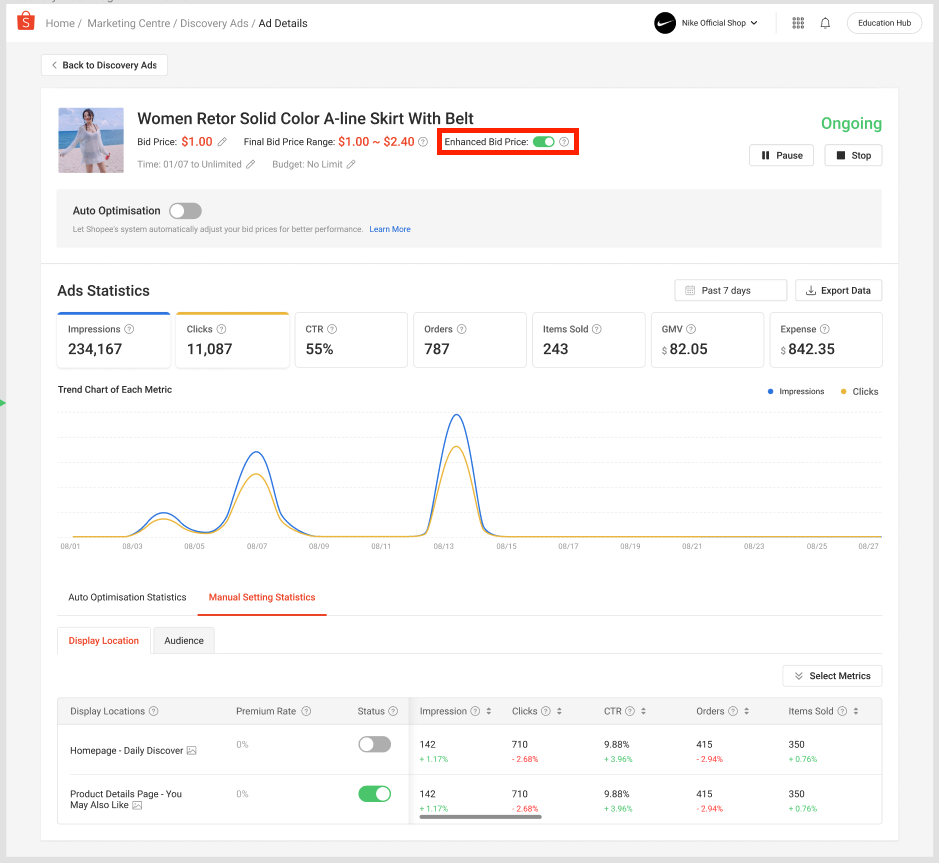
The real-time bidding mechanism on e-commerce platforms often traps sellers into overspending simply to secure top placement. Controlling your shopee ads bid price in direct alignment with actual conversion rates allows your store to maintain a competitive position while safeguarding profit margins. Fine-tuning your shopee ads bid price based on specific time slots and keyword groups provides a major advantage in optimizing your CIR (Cost-to-Income Ratio). The RentAds team breaks down a 4-step smart bidding strategy to help your shop manage cash flow effectively.
Shopee Ads Bid Price and Key Influencing Factors

Setting a high bid price alone does not guarantee prime ad placement. In practice, ad competitiveness depends equally on product relevance to search queries, listing quality, and overall historical performance. Therefore, continuously raising your bid will not necessarily deliver proportional improvements in placement.
Ad Rank Formula: Bid Price × Product Quality Score
Ad rank is determined simultaneously by your bid price and the quality or relevance of your product listing. A product backed by a high shopee ads bid price but low query relevance can easily lose impression rank to a moderately priced bid that matches buyer intent more precisely.
Before increasing your bid, inspect your product landing page first. Key elements like keyword relevance, click-through rate (CTR), conversion rate (CR), and overall product appeal directly impact your listing’s ad efficiency.
Recommended System Bids vs. Actual Cost-per-Click
The recommended bid generated by Shopee serves strictly as a benchmark based on real-time auction density and market competition. It is not a mandatory price tag. Sellers can bid lower or higher based on campaign budgets and margin objectives.
Actual incurred costs depend on the underlying charging mechanism of the specific ad format and auction outcomes. Setting a bid of 2,000 VND does not mean every click will cost exactly 2,000 VND.
If the recommended bid surges, analyze whether your cost-per-click (CPC), conversion rate, and per-order margins justify the higher entry cost. Raising your bid strictly to gain impressions without producing extra sales will drain your ad budget rapidly.
Escalation Bidding Strategy to Avoid Budget Exhaustion

Do not start with the highest possible bid simply to capture top rankings. The “escalation” method offers a structured alternative for stores seeking competitive ad placement while keeping acquisition costs under control. Rather than bidding aggressively upfront, start conservatively and adjust based on performance data.
Setting an Initial Bid at 50%–70% of Shopee’s Recommended Price
Using 50%–70% of the recommended bid provides a solid baseline for initial testing rather than a rigid rule. If Shopee suggests a 1,000 VND bid, starting around 500–700 VND allows you to gauge actual impression volume.
If a low bid yields virtually no impressions, raise it incrementally. Conversely, if click volume stabilizes but your cost per order runs too high, avoid raising your bid further just to chase higher positions.
Step-by-Step Bid Escalation Path
Instead of jumping your bid instantly from 700 VND to 1,500 VND, adjust in small increments—such as 700 → 800 → 1,000 → 1,200 VND. Allow sufficient time for the campaign to accumulate statistical data after each step before evaluating results.
The objective is not finding the highest shopee ads bid price, but discovering the sweet spot between visibility and conversion efficiency. If increasing your bid by 200 VND generates no meaningful increase in orders, the higher cost fails to deliver proportional value.
Segmenting Bid Prices by Keyword Match Types
Avoid applying a single uniform price across your entire keyword catalog. Exact match keywords represent specific buyer intent, whereas broad match keywords deliver wider reach with variable relevance.
For example, a store selling men’s running shoes should assign a higher bid to “men’s running shoes” while remaining cautious with broad queries like “men’s sports shoes”. Once click data accumulates, compare the CPC, conversion rate, and cost-per-order across groups to guide subsequent adjustments.
Key Takeaway: The 50%–70% starting benchmark and 100–200 VND escalation steps serve as testing guidelines. Your optimal bid ultimately depends on your product category, auction competition, available budget, and keyword performance.
Real-Time Bidding Tactics for Mega Sale Campaigns
Your bids should not remain static over time, especially during Mega Sale events when traffic surges and auction density peaks. However, making erratic changes prevents ad data stabilization. Adjust bids based on time slots, competitive pressure, and actual conversion efficiency rather than chasing rank positions.
Lowering Bids During Off-Peak Hours
If account analytics show specific time slots generating high click volume with low conversion rates, lower your bids during those hours to cut unnecessary spend. However, do not assume late nights or early mornings are universally off-peak.
Buyer behavior varies significantly across product categories. Office workers might shop heavily in the evening, while other categories record strong order volumes early in the morning. Analyze hourly data from previous days before lowering your bids.
Tapering Bids 3 Days Prior to Mega Sale Events
“Tapering bids” should not mean blindly slashing your bid price right before a campaign. Cutting bids too sharply three days before an event risks losing ad placement and deprives your store of critical data needed to prepare for peak volume.
Instead, split your budget into two distinct phases. Prior to the sale, maintain a sufficient bid to preserve visibility and identify converting keyword groups. On D-Day, concentrate your budget on proven, high-converting product groups rather than raising bids uniformly across your entire account.
If a product group delivers strong ROAS and high conversion rates during the warm-up phase, prioritize ad spend for that group over listings that generate high click volume without driving sales.
Handling Severe Auction Bid Inflation
When multiple competitors push their bids upward, chasing top rank placements often drives up CPC without improving profit margins. In this scenario, establish a strict maximum allowable Cost-per-Order benchmark before increasing your bid.
If an elevated bid price dilutes profit margins because conversion rates fail to keep pace, maintain a lower ad position and reallocate spend toward less competitive keywords. Additionally, review converting search queries to concentrate your ad budget on high-intent terms.
Core Principle: Mega Sale events bring aggressive auction competition, but a higher bid does not guarantee higher profit. The ultimate goal remains securing an ad cost structure that generates orders while preserving acceptable profit margins.
Evaluating the Relationship Between Bid Price, ROI, and CIR
A high bid increases listing competitiveness, but it also elevates overall marketing expenses. Rather than tracking placement rank alone, evaluate how much top-line revenue and net profit your bid generates. The three scenarios below clarify when to hold, decrease, or increase your bid.
Calculating Your Maximum Breakeven Bid Price
Your Max Bid represents the absolute highest cost per click your store can absorb while remaining profitable. Calculate your baseline Max Bid using this formula:
Max Bid ≈ Pre-Ad Profit Per Order × Conversion Rate
For example, if a product yields 100,000 VND in pre-ad profit with a 5% click-to-order conversion rate, your maximum expected ad cost baseline is approximately 5,000 VND per click. When calculating this in practice, factor in platform commission fees, store-absorbed vouchers, operational overhead, and order return/cancellation rates to avoid setting a Max Bid higher than your actual margin threshold.
Decreasing Your Bid Price on Low-Converting Keywords
A high CTR indicates that your ad creative successfully drives user clicks, but a low CR reveals that traffic is failing to convert into sales. In this situation, avoid raising your bid to acquire more traffic.
First, inspect the alignment between your target keywords and the product landing page. If a keyword drives heavy traffic but visitors bounce without buying, the issue may stem from pricing, product imagery, promotions, or query mismatch. Once poor traffic quality is confirmed, step down your bid price gradually and monitor your cost-per-order.
Increasing Your Bid Price on High-Converting Keywords
Keywords delivering a high CR, an acceptable cost-per-order, and available impression headroom represent prime candidates for a higher bid. Avoid raising bids universally; prioritize keywords with a proven track record of sales, then increase your bid price in small steps to verify if impressions and orders scale proportionally. If ad spend rises faster than revenue, halt bid increases and revert to your previous price level.
Practical Rule: CTR answers “Are shoppers clicking?”, CR answers “Are shoppers buying?”, and ROI/CIR answers “Is the ad spend worth the resulting revenue and profit?”
Contact Info
Information about “Shopee ads bid price” hopes to provide you with additional necessary knowledge. At Rentads, there is a team of highly qualified and experienced staff and experts who will provide google account for rent as well as support when you run Facebook ads. Contact us via phone number.
Frequently Asked Questions
Opt for Manual Bidding to maintain direct control over your shopee ads bid price on a per-keyword basis. Auto Bidding frequently inflates bid prices on non-performing keywords, leading to unnecessary budget waste.
The minimum bid price enforced by Shopee generally starts at 400 VND per click for product search ads, varying depending on the specific product category.

