Github increase instagram followers

GitHub is not only a source code repository but also a home to powerful tools that support social media optimization. If you are looking for automation solutions to expand your account’s influence, then using tools to github increase instagram followers is a smart choice. Let’s join RentAds in learning how to professionally select and operate these open-source scripts. The article below will help you maximize the potential to github increase instagram followers in the safest and most effective way.
Why Seek Instagram Support Tools on GitHub?

In the process of optimizing operations and growth on Instagram, the need for support tools is almost inevitable. However, the choice of the tool source directly determines the safety, control, and long-term effectiveness of the account. Instead of relying entirely on closed services, the trend of searching for solutions from GitHub is becoming increasingly popular due to their flexibility and transparency. This is not just a source code repository but an ecosystem where tools are built, verified, and continuously improved by the technical community.
Open Source
Tools to github increase instagram followers allow users to access the source code directly instead of using a “black box” like many external services. This creates a distinct advantage in terms of control: users can review functions, assess safety levels, and remove unwanted components before deployment. In reality, many security reports have pointed out that third-party applications of unknown origin can insert tracking code or collect login data. Conversely, with open source, any change leaves a public trail, making it easy for the community to detect unusual behavior. This transparency significantly reduces risks related to account data leaks or platform policy violations.
Community Support
One of the major advantages of GitHub lies in its community ecosystem. Popular projects often have hundreds to thousands of followers, contributors, and feedback loops, creating a cycle of continuous improvement. When Meta’s algorithms change, tools are quickly updated to adapt. The signs of a valuable project are not found in the description but are expressed through actual activity:
- Regular source code update frequency
- A high volume of issues being handled continuously
- Clearly contributed and moderated pull requests
These factors reflect the “liveliness” of the project, helping users avoid outdated or unmaintained tools. Instead of depending on a single provider, you are leveraging collective intelligence to ensure the tool always keeps up with platform changes.
Completely Free
Unlike many commercial services that require monthly maintenance fees, the majority of tools to github increase instagram followers are provided for free. This not only saves costs but also creates conditions to experiment with various solutions without financial constraints. In a context where many external growth services apply high-fee models while lacking transparency in their operations, using open-source tools helps users become more proactive in budget control. The cost lies almost entirely in setup and operation time, in exchange for flexible customization based on actual needs instead of being limited to fixed service packages.
How to Search for and Evaluate Tools on GitHub
Properly exploiting resources on GitHub not only shortens research time but also significantly limits risks when selecting tools for marketing or automation activities.
Using Search Keywords
An effective approach begins with building a set of keywords closely aligned with usage needs, combined with the ability to utilize available filters on GitHub. When entering terms related to automation, scraping, or API integration, the system will return thousands of repositories, but the real value lies in filtering. One of the most important technical criteria is the “Stars” and “Forks” count. Repositories with high star counts often reflect community interest, but more noteworthy is the growth rate of this index over time. Projects that are constantly updated and maintain steady growth are often tied to actual usage needs and have contributions from many developers. Additionally, the number of “Forks” indicates the extent to which a project is copied and further developed, thereby indirectly showing its applicability and scalability.
Checking the README File
After identifying potential repositories, the next step is to analyze the README content, which best demonstrates how the author intends the tool to be used. A well-invested README typically includes functional descriptions, detailed installation instructions, project structure, and technical limitations. When reading the README, pay attention to factors such as:
- Clarity in installation instructions: whether it fully mentions dependencies, running environments, and compatible versions.
- Scope of features: what behaviors the tool supports, and whether there are limits on APIs or user interactions.
- Documentation update frequency: whether the README was edited recently or is outdated compared to the current code.
Many repositories have relatively stable code but sparse READMEs, lacking implementation guides, leading to high testing costs. Conversely, projects with detailed READMEs often reflect clear product thinking while significantly reducing onboarding time. Synchronized documentation with the code is also a sign that the project is still being taken seriously.
Considering the “Issues” Section
One highly valuable but often overlooked data source is the “Issues” section. This is where the tool’s operational status is directly reflected through user feedback and exchanges between contributors. Without going deep into all content, simply observing how problems are opened, handled, and closed is enough to evaluate the project’s quality. Signals to watch for include:
- The number of open issues versus closed issues, showing the development team’s bug-fixing capability.
- Average response time from maintainers, reflecting the level of support.
- Issue content related to being blocked by platforms like Instagram, API limits, or algorithm changes.
Popular Groups of Tools to github increase instagram followers
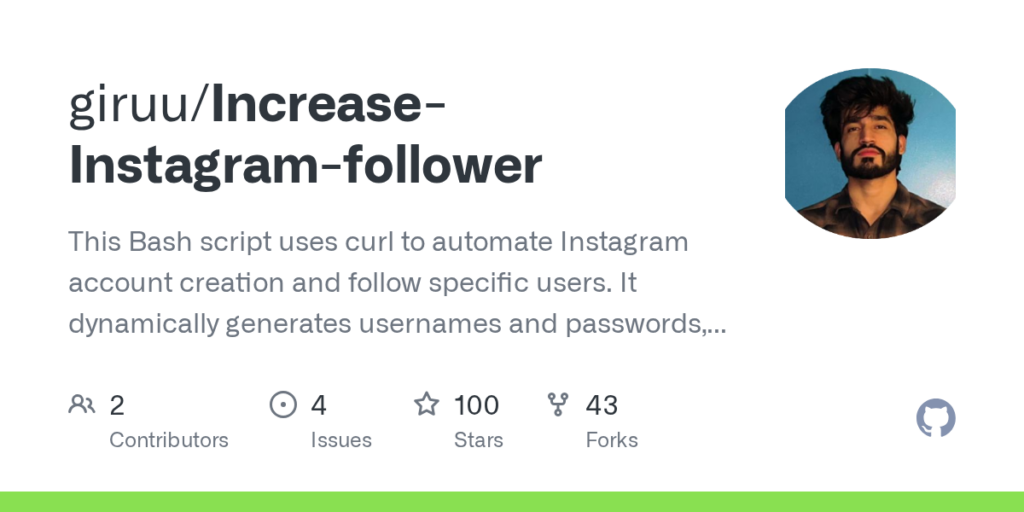
Instagram growth tools on GitHub do not develop in isolation but form clear functional groups, reflecting how developers approach the problem of expanding followers.
Interaction Automation Tools (Botting Tools)
This group of tools plays the role of creating initial “touchpoints” between the account and target users through programmed interaction behaviors. However, the value lies not in performing a large volume of actions, but in how those actions are distributed and controlled to maintain a natural appearance. Highly refined repositories often build mechanisms to follow hashtags or relevant content files, thereby placing the account in front of the right user groups likely to be interested. Like and Comment activities are deployed according to flexible logic, with adjustments in timing, frequency, and context, rather than repeating a fixed pattern easily recognized as a bot.
A noticeable difference lies in the handling of Follow/Unfollow tactics. Instead of a mass approach, many tools exploit data from competitors’ customer files or accounts in the same segment, thereby expanding reach in a selective manner. Well-maintained projects continuously update action limits and frequency spacing mechanisms, showing direct adaptation to changes in Instagram’s control systems. This is also a factor that makes the lifecycle of this tool group heavily dependent on continuous updates.
User Data Analysis and Filtering Tools
Unlike automation, the analysis tool group focuses on controlling the quality of the follower base and optimizing content performance. Their role is not in creating new followers, but in ensuring those followers are likely to interact and maintain long-term value. An important function is identifying groups that do not follow back, thereby supporting list adjustments toward a leaner direction. In well-invested repositories, this feature often comes with the ability to categorize accounts by activity level or unusual signs, helping to eliminate elements that do not bring real value.
In addition, analyzing content performance is increasingly emphasized. Tools do not stop at displaying engagement metrics; they process data to reflect user behavior trends, thereby supporting adjustments in posting strategies. Deep-reaching projects clearly demonstrate the link between data and action, allowing users to understand which content is generating good interaction and why. The combination of these two tool groups shows a systematic approach: one expands reach, while the other controls and optimizes quality. Repositories maintained by the community for a long time are usually those that balance these two factors instead of just focusing on short-term numerical growth.
Contact Info
You need a Facebook advertising account but don’t know any reputable provider. Coming to Rentads is where you will experience what you need google ads agency account for rent prestige, high trust, and professional consulting and service support for customers.
Frequently Asked Questions
You should not focus entirely on one side from the beginning. Automation helps generate initial reach traffic, but without an accompanying analysis layer, the follower base will quickly become low-quality.
It can be identified through several combined signals, such as a repository having no new commits for a long time, the Issues section appearing with many bug reports that go unhandled, or discussions mentioning that the tool no longer works with Instagram’s current API. These signs usually appear early before the tool completely loses its effectiveness.

